
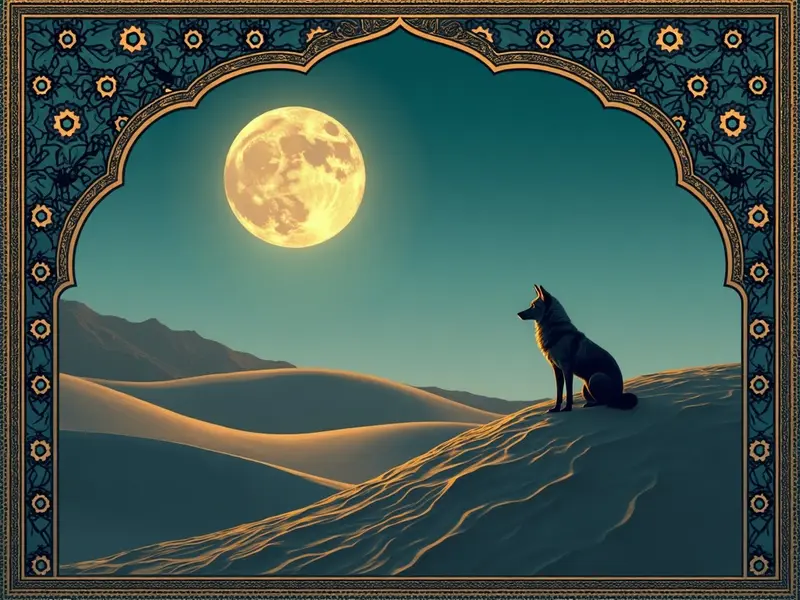
Islamic meaning of wolf in a dream
How the classical tradition of Ibn Sirin reads a wolf.
Wolves appear rarely in the earliest Islamic dream manuals, but when they do, interpreters usually tie them to danger that comes from a person rather than an animal itself. The wolf becomes a symbol for an enemy, a rival, or someone whose intentions are not sincere, often someone close enough to cause real worry if their nature were revealed.
This reading has deep roots in the Qur'anic story of Prophet Yusuf, peace be upon him, where his brothers described a wolf devouring him to explain his disappearance. Classical scholars of dream interpretation, including Ibn Sirin, often referenced this narrative when discussing wolves, treating the animal as a symbol of harm attributed to human deceit rather than a literal beast.
An-Nabulsi and later interpreters expanded on this, sometimes noting that a wolf could also represent a person of worldly power, ambition, or even someone skilled but rough in character. A wolf that is calm, distant, or seen without threat was sometimes read more mildly, hinting at competition or rivalry rather than outright danger.
Across these readings, the tone stays practical. A wolf dream was traditionally seen as an invitation to stay alert to the people around you, especially in matters of trust, without assuming the worst about anyone specific.
In the classical tradition
Linked the wolf to a hidden enemy or deceitful person, often referencing the story told by Yusuf's brothers.
Broadened the symbol to include worldly ambition, rivalry, or a person of rough or forceful character.
Generally treats the wolf as a human threat in disguise rather than a literal warning about animals.
Some in the tradition read a wolf you face calmly, or one that flees, as a sign you will recognize deception before it can do harm, or that a rivalry will resolve in your favor. It can also point to hidden strength or resourcefulness rising up when you need it most.
A wolf that frightens you or draws near may reflect concern about betrayal, gossip, or someone whose true nature has not been shown yet. Traditionally this was taken as gentle encouragement to trust carefully, not as proof that harm is certain or close.
Looking for the everyday, psychological read too? See the general dream meaning of a wolf →
Frequently asked questions
›What does a wolf mean in a dream according to Islam?
Classical interpreters most often connect a wolf to a hidden enemy or a person acting with deceit, drawing on the Qur'anic story of Yusuf. The meaning is usually about human character rather than the animal itself, and details like the wolf's behavior can shift the reading.
›Is seeing a wolf in a dream a bad omen in Islam?
Not necessarily. Many in the tradition treat it as a cautionary symbol rather than a fixed bad omen, often pointing toward alertness around trust or rivalry. Some readings are even hopeful, especially if the wolf is calm or retreats in the dream.
›Does a wolf in a dream always mean betrayal?
No single meaning is guaranteed in the classical tradition. Context, such as the wolf's behavior, your feelings in the dream, and your own life circumstances, all shape how interpreters like Ibn Sirin or An-Nabulsi might read the image.
›What did Ibn Sirin say about wolves in dreams?
Ibn Sirin is often associated with linking wolves to enemies or deceptive people, partly through the story told by Yusuf's brothers. His interpretations were general guidance rooted in his era, not fixed rulings meant for every dreamer today.