
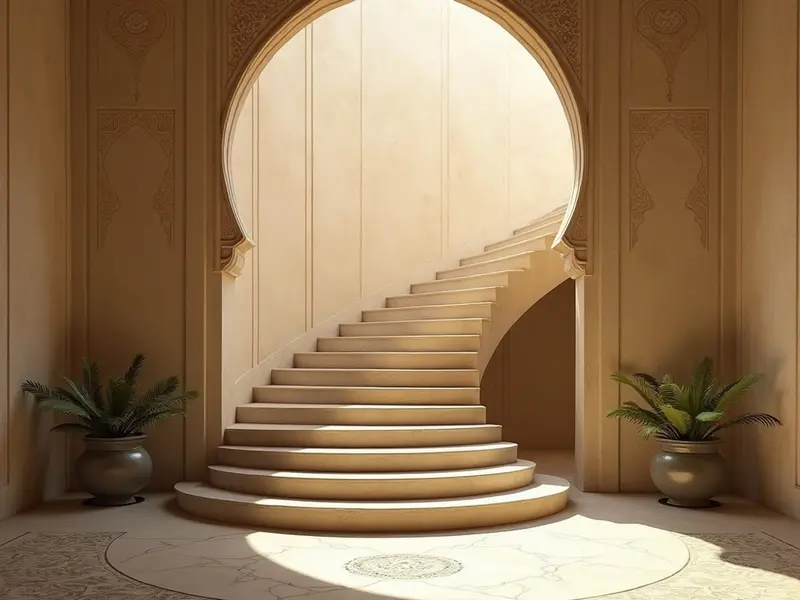
Islamic meaning of stairs in a dream
How the classical tradition of Ibn Sirin reads stairs.
Stairs show up often in the older Muslim dream manuals, and interpreters like Ibn Sirin and later An-Nabulsi generally treated them as a picture of movement between one state and another. A staircase is not a flat road. It suggests effort, patience, and stages, which is often how these scholars read a person's rise in status, knowledge, wealth, or nearness to what is good.
Climbing stairs in a dream was frequently linked to gradual gain rather than a sudden leap. The classical writers were fond of symbols that unfold slowly, and stairs fit that pattern well. Reaching a high landing, an open door, or light at the top was sometimes taken as a hopeful sign of honor, a promotion in one's affairs, or growth in one's faith and character.
Going down a staircase was read a little differently. Some in the tradition connected descent with humility, a change in circumstances, or simply a natural pause before a new stage begins. It was rarely treated as something to fear. More often it was seen as part of the same larger climb, a normal dip in a longer journey upward.
It helps to remember the wider spirit of this tradition. Good and comforting dreams have long been regarded as a gift, and the beautiful dream story of the Prophet Yusuf, peace be upon him, is often mentioned as the clearest example of how a dream can carry meaning and unfold gently over time. Stairs, in that same spirit, are usually seen as encouraging rather than something to worry over.
In the classical tradition
Often associated stairs with rising rank, gradual increase in wealth or standing, and forward movement in one's affairs.
Tended to connect the condition of the stairs, whether solid, broken, or grand, with the ease or difficulty of the path the dreamer was on.
Generally read descending stairs as a gentle pause, humility, or a shift in season rather than a loss or a warning.
Many in the tradition welcomed a dream of climbing solid, well-built stairs, seeing it as a hint of coming honor, growth in knowledge or faith, improved standing, or steady progress toward something the dreamer has been working patiently to reach.
Broken, crumbling, or unstable stairs were sometimes read as a nudge to slow down, rebuild a shaky foundation, or be patient with a plan that is not yet solid. This was generally seen as gentle guidance rather than a warning of harm.
Looking for the everyday, psychological read too? See the general dream meaning of stairs →
Frequently asked questions
›What does stairs mean in a dream in Islam?
In the classical Muslim dream tradition, stairs are commonly read as a symbol of movement between stages, often connected to rising status, gradual gain, or spiritual growth. The meaning tends to shift with details like direction, the condition of the stairs, and how the dreamer feels while on them.
›Is climbing stairs in a dream a good sign in Islam?
Many classical interpreters, including Ibn Sirin, generally viewed climbing sturdy stairs as an encouraging sign, often linked to advancement, honor, or steady progress in one's life or faith. It was usually read as hopeful rather than something to be anxious about.
›What does going down stairs in a dream mean in Islam?
Descending stairs was often read as a season of humility, a natural pause, or a shift in circumstances rather than a loss. Some in the tradition saw it as simply one part of a longer upward journey, not a sign that something bad is coming.
›Does the Islamic tradition treat all dream symbols the same way?
No. Classical interpreters like Ibn Sirin and An-Nabulsi paid close attention to small details, such as the dreamer's feelings, the condition of the stairs, and what happened at the top or bottom, since these details were believed to shape the meaning of the dream.