
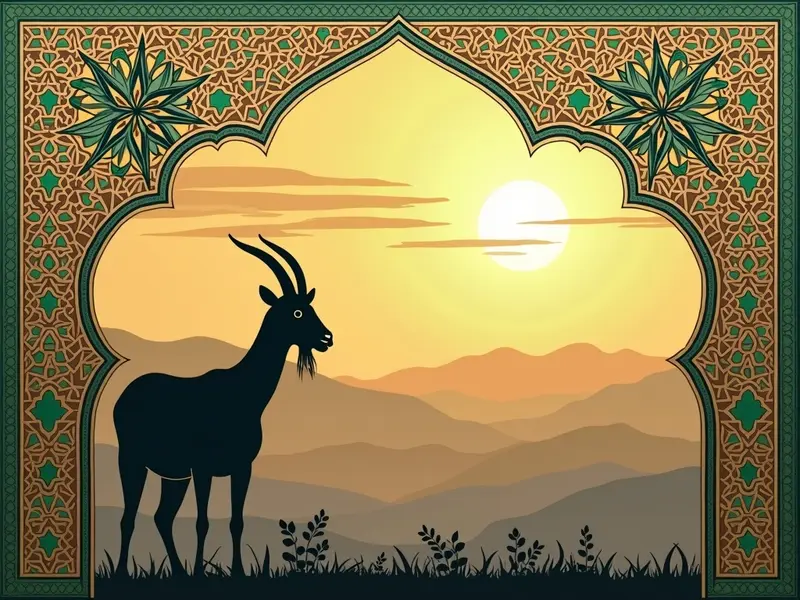
Islamic meaning of goat in a dream
How the classical tradition of Ibn Sirin reads a goat.
A goat wandering through a dream has long been read by Muslim dream interpreters as a sign touching on livelihood, family, and modest gain. In the classical tradition, animals that provide milk, meat, or wool were often tied to sustenance and the people who supply it, so a goat could point to a helper, a relative, or a source of steady provision entering the dreamer's life.
Ibn Sirin and later scholars like An-Nabulsi paid close attention to details. A healthy, calm goat was usually taken as a good sign, hinting at ease, a modest but honest income, or a dependable person nearby. A thin, aggressive, or wounded goat was sometimes read more cautiously, as a nudge to watch over one's finances, health, or a relationship that feels strained.
Color carried weight too. A white goat was often linked to purity of intent or a clean source of earnings, while a black goat could point to hidden matters needing patience rather than alarm. None of these readings were ever treated as fixed law; they were offered as reflections, since only God fully knows the truth behind any dream.
It's worth remembering that the wider Islamic view of dreams honors them as a possible gift, echoing the story of Prophet Yusuf, peace be upon him, whose true vision unfolded with patience over time. A goat, in that spirit, is usually seen as a small, humble image carrying a quiet, hopeful message rather than a dramatic sign.
In the classical tradition
Often connected the goat to modest livelihood, a helpful person, or steady household provision.
Paid close attention to the goat's color and condition, reading a healthy animal as favorable and a sickly one as a gentle caution.
Generally held that a calm, well-fed goat pointed to ease, while a wild or injured one called for patience and care in daily matters.
Many in the tradition read a healthy, calm goat as a hopeful sign of steady provision, a reliable helper, or modest financial ease arriving without struggle. It can also reflect a gentle, unassuming person in the dreamer's life whose presence quietly brings comfort, stability, or practical support during a season that needs it.
A thin, aggressive, or injured goat has sometimes been read as a gentle nudge to look after one's health, finances, or a strained relationship rather than a warning of harm. Classical interpreters treated this as encouragement to act with care and patience, never as a fixed prediction of hardship or loss.
Looking for the everyday, psychological read too? See the general dream meaning of a goat →
Frequently asked questions
›What does a goat mean in a dream in Islam?
In the classical Muslim dream tradition, a goat is often associated with modest wealth, provision, or a simple, dependable person in the dreamer's life. Interpreters like Ibn Sirin generally viewed a healthy goat as a favorable sign, while its color and condition could shift the meaning toward either comfort or gentle caution.
›Is seeing a goat in a dream a good sign in Islam?
Many classical interpreters leaned toward reading a calm, healthy goat as a good sign, often linked to steady provision or a helpful person nearby. The tradition never treats this as guaranteed, since the dream's condition, color, and the dreamer's own life details all shaped the reading.
›What does a black goat mean in a dream according to Islamic tradition?
A black goat has sometimes been read by scholars like An-Nabulsi as pointing to something hidden or not yet clear, calling for patience rather than worry. It was not typically treated as a bad omen, but as an invitation to move thoughtfully in an unresolved matter.
›Does a goat in a dream relate to money in Islamic interpretation?
Yes, many classical readings connect goats to modest livelihood, since the animal historically provided milk, meat, and wool for a household. A well-cared-for goat was often seen as a sign of steady, honest provision rather than sudden or dramatic wealth.