
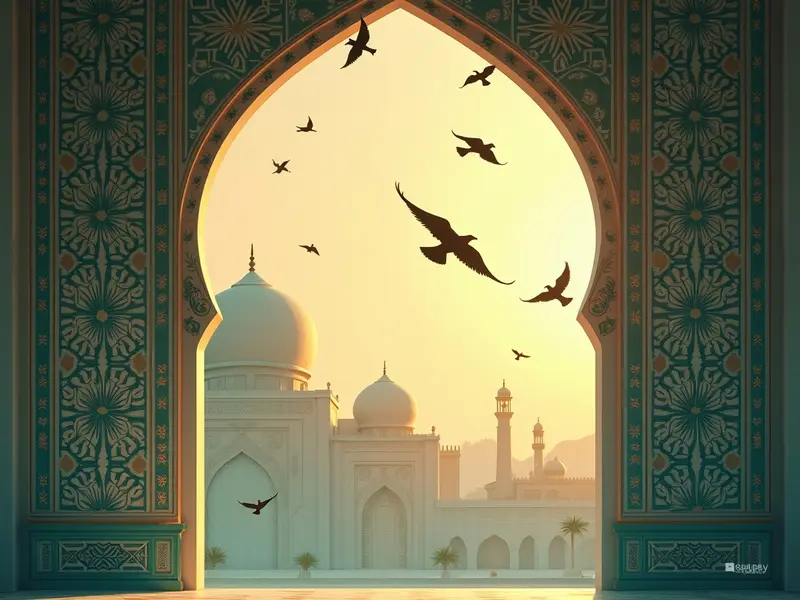
Islamic meaning of birds in a dream
How the classical tradition of Ibn Sirin reads birds.
In the classical tradition of Muslim dream interpretation, birds carry rich, layered meaning. Interpreters such as Ibn Sirin often connected birds to the soul itself, to one's reputation among people, or to news that is about to arrive, whether welcome or difficult.
The kind of bird mattered a great deal to these early scholars. A dove or pigeon was frequently read as a gentle sign tied to family, a peaceful heart, or a modest and honorable person. Birds of prey, like hawks or falcons, were sometimes linked to a person of strength, status, or worldly ambition, depending on how the bird appeared and behaved.
Color and movement shaped the reading too. A white bird was often seen as a hopeful sign, while a black or dark bird could point to a passing worry or an unclear situation rather than anything fixed or certain. A bird flying high and free was generally welcomed as a sign of a rising reputation, good tidings, or a lightened heart, while a caged, injured, or dying bird was sometimes read as a gentle image of restriction, delay, or a matter needing patience.
It's also worth remembering the dream of Prophet Yusuf, peace be upon him, which the Islamic tradition holds up as an example that true dreams can carry real meaning and are considered, in this tradition, a kind of gift. Bird dreams are read in that same spirit: as symbols to sit with thoughtfully, not as fixed predictions.
In the classical tradition
Read birds broadly as signs of the soul, one's reputation, or approaching news, with the bird's type and color shaping the meaning.
Elaborated on specific birds, tying doves and pigeons to family and peace, and stronger birds to status, power, or ambition.
Generally treats a bird's flight, color, and condition (free, caged, injured) as key details that shift the tone of the dream.
A bird flying freely, singing, or landing gently is widely welcomed in this tradition as a sign of good news, a lightened heart, rising honor, or a peaceful turn in one's family life. Many interpreters treat such dreams as gentle encouragement rather than anything to overanalyze.
A caged, injured, or frightened bird is sometimes read as a mild sign of feeling restricted, delayed, or unsettled about a situation in waking life. Classical interpreters treated this gently, as a nudge toward patience and reflection, not as a warning to fear.
Frequently asked questions
›What does seeing birds in a dream mean in Islam?
In the classical tradition, birds are often linked to the soul, one's reputation, or news on its way. Interpreters like Ibn Sirin looked closely at the bird's type, color, and behavior, since a dove, a bird of prey, or a caged bird were each read somewhat differently.
›Is a white bird a good sign in a dream according to Islamic tradition?
Many classical interpreters read a white bird as a hopeful sign, often tied to good news, purity of intention, or a peaceful turn of events. Still, this tradition encourages reading the whole dream, including the bird's behavior, rather than focusing on color alone.
›What does a flying bird symbolize in an Islamic dream interpretation?
A bird flying high and freely is often welcomed in the tradition as a sign of a rising reputation, relief from a burden, or good tidings arriving soon. The sense of ease or joy felt in the dream is usually seen as part of the meaning.
›Does a dead or injured bird in a dream mean something bad in Islam?
Classical interpreters tended to read this gently, often connecting it to a passing worry, a delay, or a situation calling for patience rather than anything to fear. The tradition treats such images as symbolic, not as a sign about actual harm.