
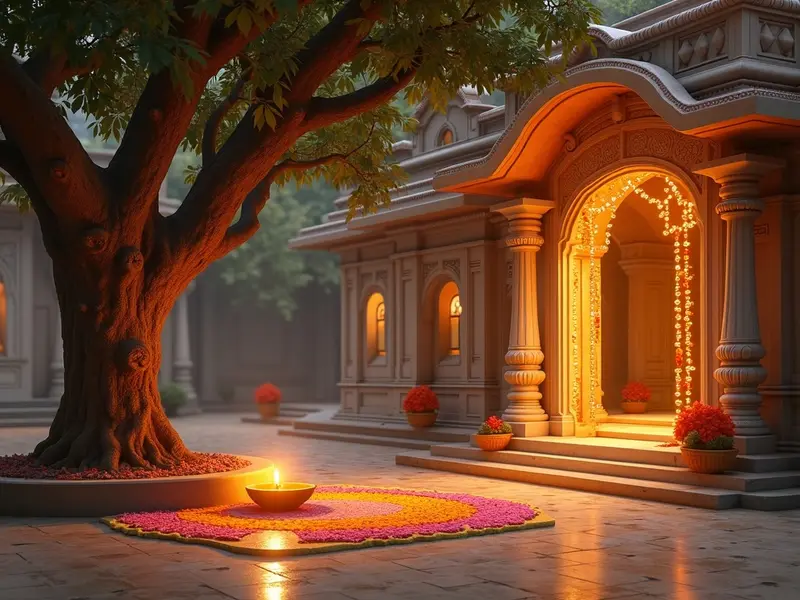
Hindu meaning of tree in a dream
What Swapna Shastra and traditional belief see in a tree.
Trees have long held a quiet, sacred place in Indian life, from the banyan sheltering a village square to the tulsi plant tended outside a home. So it makes sense that in Swapna Shastra, the old tradition of Hindu dream reading, a tree in a dream is rarely seen as a small or random image. It is treated as a symbol worth sitting with.
Traditional belief holds that a healthy, leafy tree often reflects the dreamer's own life taking root — family, career, or personal growth steadying itself after a period of uncertainty. A tree full of fruit or flowers is frequently read as a sign of coming abundance, the kind that grows slowly rather than arriving all at once.
A dry, bare, or falling tree is not meant to frighten anyone. Many families read this simply as a nudge to pay closer attention to health, relationships, or responsibilities that have been quietly neglected, rather than as a warning of anything serious.
Some regional customs also connect certain trees to specific blessings, such as the peepal tree's association with wisdom and ancestral peace, or the neem tree's link to protection and healing. These readings sit alongside the broader Swapna Shastra tradition, offering another gentle layer of meaning.
In Swapna Shastra and tradition
A green, thriving tree is generally read as a sign of steady growth, family stability, and blessings that are building over time.
Fruit or flowers on the tree are often seen as a hopeful marker of abundance and reward for patient effort.
Certain trees like peepal or neem carry their own local associations with ancestral peace, wisdom, or protection in various parts of India.
A tree full of leaves, fruit, or flowers is widely read as an auspicious sign in Swapna Shastra, pointing toward growth, prosperity, and a life gaining steady roots. Many see it as encouragement that patient effort, family bonds, or long-term plans are quietly moving in a favorable direction.
A withered, bare, or falling tree is not read as bad luck in a frightening sense. Traditional belief often treats it as a gentle reminder to check in on health, relationships, or duties that may have been overlooked, with the understanding that attention now can help things recover.
Looking for the everyday, psychological read too? See the general dream meaning of a tree →
Frequently asked questions
›Is seeing a tree in a dream good or bad in Hinduism?
In most Hindu dream traditions, seeing a tree is read as generally good. Swapna Shastra tends to connect trees with growth, stability, and blessings, especially when the tree looks healthy or is bearing fruit or flowers. A withered tree is read more as a gentle caution than a bad omen.
›What does a fruit-bearing tree mean in a Hindu dream?
A fruit-bearing tree is often considered one of the more auspicious tree dreams in Swapna Shastra. Traditional belief links it to reward for past effort, financial or family growth, and blessings that have been slowly ripening, arriving in their own natural time rather than suddenly.
›Does a dead or falling tree in a dream mean something bad?
Not necessarily. Many readers of Swapna Shastra see a dying or falling tree as a soft signal to pay attention to health, relationships, or responsibilities, rather than as a serious warning. It is generally treated as a call for care, not something to fear.
›Does the type of tree matter in Hindu dream interpretation?
Yes, in many regional customs the specific tree can add meaning. A peepal tree is often linked to wisdom and ancestral peace, while neem is associated with protection and healing. These details sit alongside the broader Swapna Shastra reading of trees as symbols of growth.