
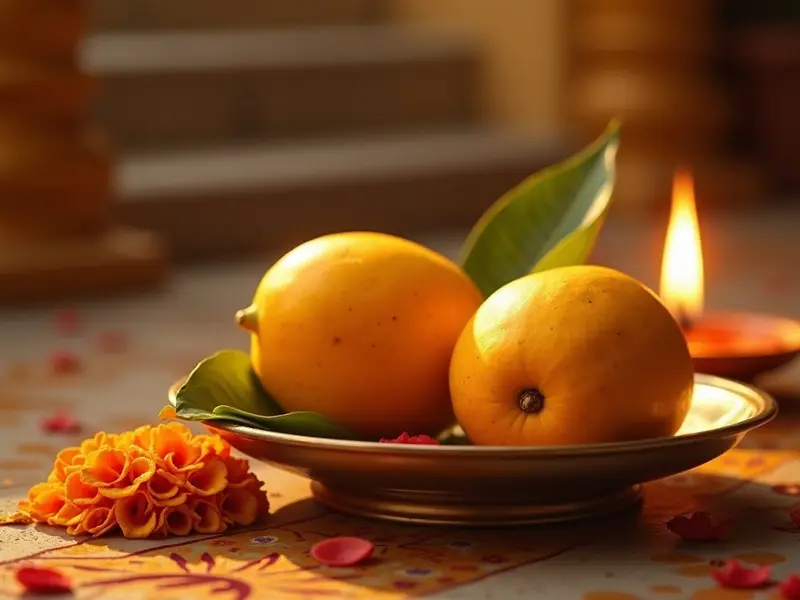
Hindu meaning of mango in a dream
What Swapna Shastra and traditional belief see in a mango.
The mango holds a warm place in Indian life long before it shows up in a dream. It is the fruit of summer, of weddings, of festivals, and of the humble everyday joy of sharing something sweet with family. So when a mango appears in sleep, Swapna Shastra tends to read it in that same spirit, as a sign touched by good fortune rather than worry.
Traditional belief often connects the mango to fertility and new beginnings, since the tree itself is considered sacred and its leaves are used in doorway decorations for weddings and pujas. A dream of eating a ripe mango, or receiving one as a gift, is commonly read as a hint of coming happiness, a celebration, or welcome news within the family circle.
Context matters gently in this tradition. A mango tree heavy with fruit is often seen as a sign of prosperity taking root. Picking mangoes may point to reaping the reward of past effort. An unripe mango can suggest that something good is on its way but simply needs more time, while a spoiled or wormy mango is sometimes read as a soft nudge to look after health or tend to a relationship before it goes sour.
None of these readings are meant as certainty. Swapna Shastra offers a lens, not a verdict, and many families simply enjoy noticing the sweetness of the symbol before moving on with their day.
In Swapna Shastra and tradition
Generally classifies the mango among fruits of good fortune, tied to sweetness, abundance, and family joy.
Connects the mango tree and its leaves to fertility, weddings, and sacred household rituals.
In many South Indian households, dreaming of mangoes during summer is sometimes linked to festival timing and seasonal blessings.
A ripe, sweet mango in a dream is widely read as auspicious in Swapna Shastra, a sign of coming happiness, abundance, or good news for the family. It may point to a celebration on the horizon, a fertile new beginning, or simple contentment settling into daily life.
An unripe or spoiled mango is sometimes read more cautiously, as a gentle reminder that good things may still need time to ripen. It is rarely seen as a bad omen so much as an invitation to be patient, and to tend carefully to health or relationships that matter to you.
Looking for the everyday, psychological read too? See the general dream meaning of a mango →
Frequently asked questions
›Is seeing a mango in a dream good or bad in Hinduism?
Traditionally, it leans good. Swapna Shastra generally treats a mango as an auspicious symbol tied to sweetness, abundance, and family happiness. An unripe or rotten mango is sometimes read as a softer caution about patience or health, but it is rarely treated as a frightening sign.
›What does eating a mango in a dream mean in Hindu tradition?
Eating a ripe mango in a dream is often read as a sign of enjoying the fruits of your own effort, or of welcome news and celebration coming your way. Some readings connect it to contentment in family or married life, since the mango carries strong associations with domestic sweetness.
›Does a mango tree in a dream have special meaning?
Yes, a mango tree full of fruit is commonly linked to prosperity taking root over time, since the tree itself is considered sacred in many Hindu rituals. It is often read as a gentle sign of stability and abundance building steadily in one's life.
›What if the mango in my dream was rotten or unripe?
This is usually read gently, not as a bad omen but as a nudge toward patience. Traditional belief suggests good things may still be ripening, or that a little more care toward health or a relationship could help things turn out sweeter.