
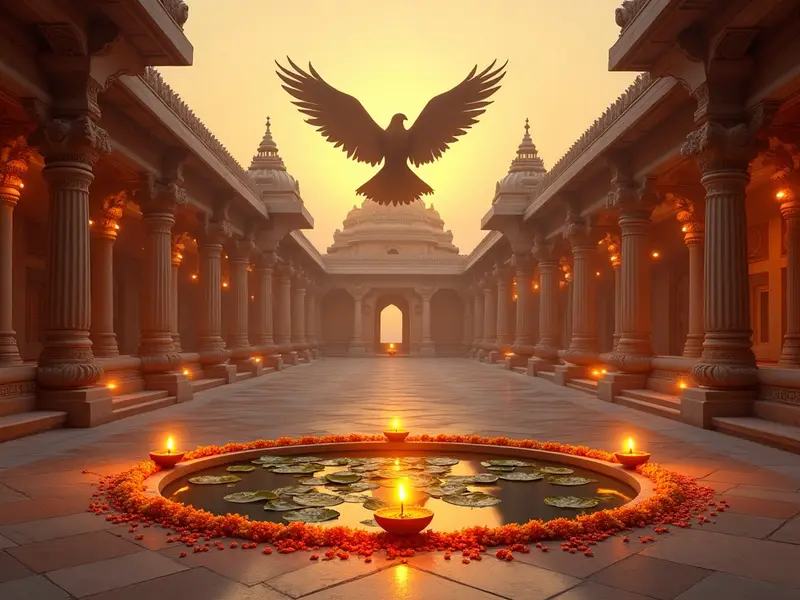
Hindu meaning of eagle in a dream
What Swapna Shastra and traditional belief see in an eagle.
In Swapna Shastra, birds that soar high are usually read as messengers of good fortune, and the eagle carries extra weight because of its association with Garuda, the great bird who carries Lord Vishnu. Seeing an eagle in a dream is traditionally felt to reflect strength, protection, and the ability to rise above whatever is weighing on you.
Many families read a soaring eagle as a sign that obstacles are about to lift, or that a period of struggle is giving way to clarity and forward motion. The eagle's height and steady wings are often linked to confidence, sharp thinking, and a kind of quiet fearlessness that the dreamer may be growing into.
If the eagle in the dream feels calm, watchful, or is simply gliding, traditional belief tends to see this as reassuring, almost like a protective presence keeping an eye on your path. If the eagle appears aggressive, injured, or is fighting another creature, some interpreters gently suggest it may point to inner conflict, pride, or a battle you feel you must win, though this is read as a nudge to reflect, not a warning of misfortune.
Because Garuda is also seen as a devoted guardian, some who follow this tradition feel that dreaming of an eagle can carry a sense of being watched over, especially during a time of change or uncertainty in waking life.
In Swapna Shastra and tradition
Reads a high-flying or calm eagle as a sign of rising fortune, courage, and protection.
Connects the eagle to Garuda, Lord Vishnu's vahana, linking the dream to guardianship and steady strength.
In some households, an eagle circling overhead in a dream is seen as a quiet reassurance that difficulties are passing.
A soaring or steady eagle is traditionally read as one of the more encouraging bird dreams in Swapna Shastra. It is often linked to Garuda, suggesting protection, rising confidence, and the sense that you are gaining the strength or clarity needed to move past a current challenge.
If the eagle seems aggressive, wounded, or locked in struggle, some traditional readings gently connect this to inner tension, pride, or a conflict weighing on your mind. This is not treated as a bad omen so much as a quiet invitation to notice where you might be pushing too hard or feeling unsettled.
Looking for the everyday, psychological read too? See the general dream meaning of an eagle →
Frequently asked questions
›Is seeing an eagle in a dream good or bad in Hinduism?
Most traditional readings lean positive, especially when the eagle is calm or flying high, since it is linked to Garuda and themes of protection and rising strength. A tense or fighting eagle is read more as a nudge toward self-reflection than a sign of bad luck, and even that reading is treated gently.
›What does an eagle attacking something in a dream mean in Hindu tradition?
Some interpreters connect this image to an inner struggle, such as pride, conflict, or a challenge you feel you must overcome. It is generally not read as a frightening sign, but as an invitation to notice where you may be feeling pressure or tension in waking life.
›Does an eagle in a dream relate to Garuda?
Yes, many people draw a natural link between an eagle in a dream and Garuda, the great bird who serves as Lord Vishnu's vahana. This connection often shapes the reading toward protection, courage, and a sense of being watched over during change.
›What does it mean if the eagle is just flying calmly overhead?
A calm, steady eagle is often felt to be one of the more reassuring images in Swapna Shastra. Traditional belief tends to read it as a sign of quiet strength, protection, and the feeling that things are beginning to move in a more hopeful direction.