
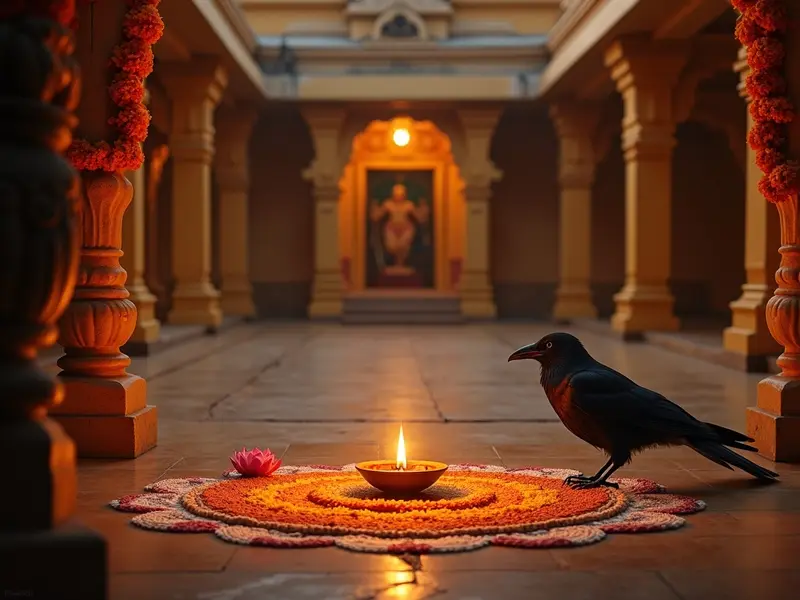
Hindu meaning of crow in a dream
What Swapna Shastra and traditional belief see in a crow.
Crows hold a special place in Hindu household life, especially around Shraddha and Pitru Paksha, when offerings are set out for crows as stand-ins for ancestors. So when a crow shows up in a dream, Swapna Shastra and everyday family tradition often connect it first to pitru, the departed elders of the family, rather than to anything frightening.
A single crow cawing or watching quietly in a dream is traditionally read as a sign that a message is on its way, sometimes news from far away, sometimes simply a feeling that someone from the family, living or passed on, is thinking of you. Many families take this as gentle reassurance that ancestors are keeping watch, not as anything to dread.
A crow eating or accepting food in a dream is usually seen as a good sign in this tradition, echoing the real-world practice of feeding crows to honor ancestors. It can be read as ancestors being pleased or satisfied, which many understand as blessings quietly flowing back to the dreamer and the household.
If the crow in the dream seems agitated, is being chased, or appears injured, traditional interpreters tend to read this softly, as a hint to slow down, tend to family duties, or perform small rituals of remembrance, rather than as a prediction of misfortune. The tone in Swapna Shastra stays practical and calm, pointing toward attention and care, not fear.
In Swapna Shastra and tradition
Generally links crows to ancestors, pitru, and incoming messages or news.
A crow accepting or eating food in a dream is often read as ancestors' blessings reaching the family.
In many Indian households, a crow cawing near the home, in waking life or dreams, is linked to visitors or news arriving soon.
A calm or well-fed crow in a dream is widely read as an auspicious sign in Hindu tradition, suggesting ancestors are pleased and blessings are flowing toward the household. It can also point to welcome news arriving soon, or a quiet sense of being watched over by family who came before.
A restless, injured, or aggressive crow is sometimes read as a gentle nudge rather than a bad sign, pointing toward neglected family duties or ancestral rites that could use attention. Traditional interpreters generally see this as guidance toward care and remembrance, not as something to fear.
Looking for the everyday, psychological read too? See the general dream meaning of a crow →
Frequently asked questions
›Is seeing a crow in a dream good or bad in Hinduism?
Traditional interpreters mostly lean toward it being a good or neutral sign, especially if the crow seems calm or is eating. Since crows are linked to ancestors in Hindu custom, the dream is often read as a message or blessing from family who came before, more than a warning.
›What does it mean if a crow caws in a dream?
In Swapna Shastra, a cawing crow is commonly tied to incoming news, sometimes about travel, family, or an unexpected visitor. Many families also read it as ancestors making their presence gently known, rather than as anything alarming.
›Does dreaming of a dead crow mean something bad?
Not necessarily. Traditional dream lore often treats unsettling images gently, and a dead or still crow can be read as a sign that a worry is coming to an end, or that it's a good time to honor ancestors through prayer or small offerings.
›Why are crows connected to ancestors in Hindu belief?
During rituals like Shraddha, food is offered to crows as representatives of departed ancestors, based on the belief that they carry these offerings to the other world. This is why crows in dreams are so often linked to pitru and family memory.